Tuesday, October 26, 2021

Rudolph Valentino: Latin Lover to Spirit Guide

Rudolph Valentino was born Rodolfo Alfonso Raffaello Pierre Filiberto Guglielmi di Valentina d'Antonguella in Apulia, Italy. Valentino immigrated to America at age 18 and eventually became one of the most famous silent film stars of the 1920s. 

Due to his "exotic" appearance he became one of the first Hollywood sex symbols and was given the nickname "the Latin Lover". He stared in classic silent films such as The Four Horsemen of the Apocalypse, The Sheik, Blood and Sand, The Eagle, and The Son of the Sheik

Valentino was raised a Roman Catholic, and had fond memories of his mother’s particularly strong Catholic faith. However, his own personal faith in the Catholic Church essentially stopped there. Valentino would become very interested in a variety of spiritual topics due to his second wife, Natacha Rombova. Natacha was fascinated by Ancient Egyptian mythology, Reincarnation, Theosophy, and Spiritualism, and encouraged Valentino to study these subjects as well. 

We know from various sources that Valentino regularly attended several seances with Natacha, and also regularly consulted psychic readers while living in California. Valentino eventually began to practice mediumship and found that he had a gift for automatic writing, sometimes giving communications from his Spirit Guides named Black Feather (a Native American spirit) and Meselope (An Ancient Egyptian spirit). In 1923 he published a small volume of poetry titled Day Dreams which were supposedly written during automatic writing sessions. 

Valentino unexpectedly passed away at age 31 in 1926 due to medical complications and misdiagnosis, and was laid to rest in Hollywood Forever Cemetery. 

Although Valentino and Natacha were divorced about a year before his death, it was at a séance hosted by Natacha in November 1926, just a few months after his death, where the spirit of Valentino first delivered messages from the spirit world. The séance was conducted by a medium from the American Society for Psychical Research. A newspaper article contained Valentino's messages from the seance sumarized by Natacha: 

"Valentino is a citizen of the Astral Plane, He hopes to be a legitimate actor there, He has met Enrico Caruso and has heard the late tenor sing, He has visited theaters (on the worldly plane) where his pictures were being shown and has been pleased at the "flattery" he sensed in the minds of the audience, Everything in the theater, however, now seems strange to him as he "can see through all things."

In December 1927 a year after his death, a Spiritualist Medium named Carol McKinstry claimed that the spirit of Valentino came to her during a séance in Binghamton, NY and requested her assistance in transcribing a script that she would later publish as a book titled The Return of Rudolph Valentino. The book was to some extent a romantic novel that dealt with the subjects of spiritual development and reincarnation. 

The spirit of Valentino continued to work with Mckinstry for the rest of her life offering lessons and teachings on the principles of Spiritualism and metaphysics of the spiritual world.  In 1941 Rev. McKinstry moved to Los Angeles to found the Rudolph Valentino Memorial Church of Psychic Fellowship IGAS (International General Assembly of Spiritualist Churches), located in North Hollywood. 

In an interview she stated that Valentino acts as a Spirit Guide and "comes to me when he has a point of view he wants to express about conditions of the world." In addition to the messages she received from Valentino, Rev. McKinstry preached on a variety of Spiritual topics to her Hollywood congregation such as the principles of Spiritualism, as well as Buddhism, Astrology, Egyptian philosophy, and Reincarnation. 

Although Rev. Mckinstry is notable for her public promotion of Valentino as a Spirit Guide, she was not the only one who claimed to have contact with Valentino's spirit. After his death, what initially began as memorial practices from fans evolved into an almost folk saint like devotion to Valentino. 

In 1937 Roger C. Peterson, the grounds keeper of the mausoleum where Valentino was interred published a book titled Valentino The Unforgotten. In this book he recorded his experiences with visitors who visited Valentino's tomb. Although many came to visit as fans, almost half of the experiences seem to be individuals visiting his tomb for spiritual purposes. 

Almost as soon as Valentino passed away people claimed that Valentino appeared to them in dreams and visions, sometimes offering spiritual advice, and in some instances even healing them from illness. Some say they felt called by his spirit to visit his tomb to pray, a few instances recorded mention people praying to him for things such as finances or to find a job. A few of these individuals identified as Spiritualists and Psychics, most were simply people who felt simply felt connected to Valentino. The book Valentino The Unforgotten was out of print for several years but has thankfully been put back into circulation by the Valentino researcher Tracy Ryan Terhune. 

These fans and devotees turned his grave to a place of pilgrimage, leaving flowers, cards, small offerings, or simply going to meditate and pray near their beloved Valentino. Many of these fans and devotees around the world began to organize into memorial guilds, societies, and clubs in order to honor the memory of Valentino. Many of these would participate in the annual memorial held at Valentino's grave in Hollywood Forever Cemetery, which continues to be held to this day. 

One of these guilds, the Rudolph Valentino Guild, London was organized by the British Spiritualist Medium, Leslie Flint. Leslie Flint was the President of this organization, and had collected something of a small museum of Valentino films and memorabilia. This society would regularly meet once a month to watch a Valentino film in a venue attached to Flint's house.

Leslie Flint was one of the most well known Spiritualists to have come from England in the modern era. He was known for his direct voice mediumship. Direct voice is a form of physical mediumship that occurs when spirits use the magnetic energies from the medium's body to create an audible voice outside the body of the medium (rather than an inner voice, or using the medium's voice in a trance state) that all in attendance can audibly hear with their own ears. 

A book was published in 1965 titled the Voice of Valentino, which contained teachings derived from seances conducted by Flint where he manifested the voice of Valentino through his mediumship. Several of these sessions are available to listen for free online through the Leslie Flint Trust, and several of the recordings include a spirit voice that Flint claimed was the spirit of Valentino. Flint continued to promote his interest in Valentino up until his death in 1994. 
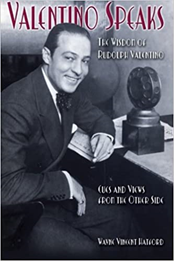
In 2004 author and medium Wayne Hatford began a series of automatic writing sessions channeling the spirit of Valentino. Similar to Rev. McKinstry, these sessions developed into a spiritual mission guided by the Spirit of Valentino to “help each of us achieve greater degrees of awareness, inner alignment, and personal growth.” 

These teachings were published in 2011 as the work Valentino Speaks: The Wisdom of Rudolph Valentino: Cues and Views from the Other Side. In the year 2020 another volume was published by Hatford titled Rudolph Valentino on the 2020's

With almost a hundred years since his passing, Valentino's role as a Spirit Guide within the Spiritualist movement seems to renew itself with every generation of Spiritualists, offering messages of hope and wisdom to anyone who cares to listen.  

Monday, October 11, 2021

Rev. Anthony Camardo

I came across Rev. Anthony Camardo while I was researching Italian-Americans involved with American Spiritualism, and he's quickly become one of my favorite people I've researched. Rev. Anthony Camardo was an Italian-American Spiritualist from Chicago. He was described as "a short and cheerful man," affectionately called "Tony" by his congregation. He was founder of the Liberal Psychic Science Association, and Pastor of the Liberal Psychic Science Church. 

In 1928 the 27 year old Camardo was drawn into a somewhat high profile criminal investigation. An eight year old named Billy Ranieri was kidnapped on his way home from school in Chicago, and held for ransom. Ranieri was rescued and his kidnappers were caught, and it was discovered that one of the men had a business card of Anthony Camardo's in his wallet. Camardo was questioned by the State Attorney; he explained that he had only met the man once, and that he was brought as a guest to a séance that he had facilitated. 

In 1935 Anthony Camardo was listed as a member of the First Italian Spiritualist Church, where he would regularly assist in Sunday Services. By 1937 Rev. Anthony was ordained as a Spiritualist Minister and was leading his own congregation; in 1941 he formed his own Spiritualist Association, the Liberal Psychic Science Church. 

A few different articles describe Camardo's church; the main entrance lead to a fellowship hall on the ground floor. This fellowship hall had folding chairs and several tables with small packages of incense for sale for 25 cents. A reporter made note of a few song birds that were in cages, a parrot, a few tanks of fish, and two resting dogs (a spaniel and a bulldog) were present in the fellowship hall during his visit. 

The sanctuary was somewhat dark, with rows of folding chairs; the platform had a lectern, and a wooden altar table with a cross. The windows in the sanctuary overlooked a small garden. There was a painting of Jesus in a white robe, a few statues of Catholic Saints, and some busts of figures in Turbans. 

The church hosted regular Sunday Services, as well as Wednesday night services. The congregation also met for monthly development circles. One particularly interesting feature of Rev. Camardo's church service is that in addition to Healing and Messages typical of most Spiritualist Churches, the Liberal Psychic Science Church also offered Communion to the congregation on a fairly regular basis, which is somewhat unusual for most Spiritualist Churches.

The Church also had an auxiliary organization called the Liberal Psychic Science Welfare Federation, which organized events such as a Christmas Bazaar, Holiday Parties, and Church dinners (chicken and spaghetti, lasagna, and ravioli were mentioned).

In 1948 Camardo served as President of the Federation of Spiritual Churches and Associations, which was the American branch of the International Spiritualist Federation. He served alongside notable Spiritualists such as John & Helen Gerling of Rochester, New York and also Rev. A. Mae Baxter Gruner, the President of Harmony Grove Spiritualist Camp in Southern California. He was described as one of the pillars of the organization: 

"Tony" Camardo has many virtues, but there is one high quality which he possesses that so overshadows all others that the one word which is most apt to characterize him is FRIENDLY. His great and good work is the true embodiment of friendlies, which reaches out to folks and makes them want to listen to the Voice of Spirit that works through him. Rev. Anthony Camardo was elected to the Federation at the Chicago Convention of 1946." 

In 1950 a reporter for the Chicago Tribune attended one of Rev. Camardo's Wednesday Night Development Circles. The meeting began at 7pm, with a gathering consisting of about 30 thirty people, mostly women, and most of them older with a handful of individuals in the 20-30 year age range. 

The meeting began with a short lecture given by Rev. Camardo on the importance of meditation for spiritual development, and also the importance of the influence of the moon on people. After a short break the Mediums prepared for the message service. Four aluminum spirit trumpets and a child's slate were placed on the floor in the center of the circle, and the lights were dimmed. The sitters were asked to place their feet firmly on the floor, with their palms resting upwards. 

The opening prayer was the 23rd Psalm, and Rev. Camardo lead the gathering in raising the vibrations for spirit communication. After about 20 minutes some small noises seemed to be produced from the Trumpet, and Camardo asked all gathered to share any messages that they had received for themselves or for others, and some for friends not in attendance. The meeting ended with coffee and cake. Camardo then invited the reporter to get pizza around the corner after everyone left. 

In 1956 Camardo lead his congregation on a retreat to Chesterfield Spiritualist Camp, where they stayed for a week to attend lectures, classes, and demonstrations of psychic phenomena. Camardo represented Chicago for "Illinois Day" during the Camp. Two notable Puerto Rican Espiritistas (Victor M. Ramos, and Judge Victorio M. Fernandez) made a special 3,000 mile trip to visit Camp Chesterfield and and study with American Spiritualists. Rev. Camardo was chosen to act as host, and helped as an interpreter for the guests. 

In a 1964 article from the Chicago Daily News, a description was given of a marriage counseling session that was conducted by Camardo for two reporters disguised as a couple. The reporters in the article openly admitted that they had not researched what the session would be like, and were disappointed that it was not similar to a psychological counseling as they had expected. Instead Rev. Camardo offered a lesson on mental healing, meditation, and positive affirmations that couples could use to improve and heal their relationship. 

Rev. Anthony Camardo passed away in January 1972 at age 71.

Monday, September 20, 2021

The Father of Harlem Spiritualists

Rev. John White is a remarkable figure that I learned about in my research into Spiritualist history. He was a highly educated and cultured man, and dedicated much of his life to teaching and preaching Spiritualism. 

He held office in General Assembly of Spiritualists, fought against segregation in Spiritualist Churches, and became President of the National Colored Spiritualist Association. I couldn't find much regarding his early life, but I did find a good amount of information on him, including a picture of him, which in itself is a rare find. 

Rev. White studied at Wilberforce University, and in 1880 he entered the Institute of Fine Arts at Chicago, where he studied Painting. He was employed by the Metropolitan Museum of Art, New York City, where he gained recognition and marked distinction within the ranks of the best copyists of his days, specifically in oil painting.

Rev. White was a member of several lodges and fraternal organizations, he was a founder of the Knights of Alpha and Ladies of Omega, a member of Elk-Gopher Lodge No. 105, St. Paul, Minn; the Grand United Order of Odd Fellows, Frederick Douglas Lodge No. 9005, St. Paul, Minn; Knights of Pythias, Pride of Minnesota Lodge, and  member of the Court of Calanthe, Minneapolis, Minn.

Rev. White was pastor of the Universal Spiritualist Church of New York City. He worked to promote Spiritualism among African-American communities of New York City, and was instrumental in organizing many Spiritualist Churches and assisting in the training and development of many Mediums and Healers for public ministry. His dedication as a missionary to spread Spiritualism in Harlem, earned him the title of the “Father of Spiritualists in Harlem.” 

Rev. White was eventually elected as a trustee on the board of the General Assembly of Spiritualists, which at the time was the New York State Auxiliary to the National Spiritualist Association. 

He became known through out the country when in 1922 the National Spiritualist Association debated in convention to segregate Spiritualist Churches. A quote from the New York Age described him as "laboring to avert a parting of the ways while he is a champion in the defense of the colored members." 

During a National Convention of the National Spiritualist Association (now known as the NSAC), a motion was proposed by a faction of Pro-Segregationist delegates that the National Spiritualist Association should adopt an official policy of full racial segregation, and vote to disaffiliate African-American members. 

After days of heated debate the convention voted to create an auxiliary for African-American Spiritualists, which would continue to be chartered through the National Association, thus allowing members to retain their membership with the National Association. 

Although at the time this was considered a victory by most, several delegates withdrew from the convention in protest, believing that the compromise for unity came at the cost of sacrificing of the principles of Spiritualism which preach the equality of all people. This dissenting movement would lead to an era of flourishing of African-American run independent Spiritualist Churches and Assemblies. 

Rev. White was elected as President of the National Colored Spiritualist Association. He took this as an opportunity for African-American Spiritualists to build up their own communities, practice self-determination, and most importantly spread the message of Spiritualism. 

He worked tirelessly as a missionary traveling throughout the United States; while in the South he visited Missouri, Florida, Louisiana, and in the North visited mostly urban areas such as Detroit, Chicago, and New York. Rev. 

White passed away at age 70 on June 21, 1926 in Harlem Hospital after a lifetime of dedication to helping others and preaching and teaching the message of Spiritualism.

Wednesday, September 15, 2021

Houngans & Mesmerists: Haitian Vodou and Mesmerism

In 1778 Dr. Franz Anton Mesmer set up a medical practice in Paris where he promoted his new theories of magnetic healing. Mesmer claimed that he had discovered a natural energy that flowed through the natural world; he called this energy “animal magnetism”. He theorized that diseases, both mental and physical, were caused by this magnetic energy being blocked or unbalanced in individuals, and developed a system of magnetic healing that would assist in restoring balance in individuals, thus curing various illnesses and conditions. 

Although his teachings were dismissed by the Royal Society of Medicine, they proved to be very popular among the upper class of French society. These aristocratic supporters of Mesmerism promoted as well as studied his teachings, learning to become healers themselves, spreading his teachings through France and other nations. 

In 1784 many members of the upper classes of the French Colony of Saint Domingue (Haiti) eagerly awaited the arrival of Count Antoine Chastent, a student who studied under Mesmer himself in Paris after undergoing a successful treatment for Asthma. Upon his arrival Count Antoine founded a Magnetic Society in Cap-Haïtien (then called Cap-Français) where he offered his services as a healer, as well as training others in the practice of Mesmerism. He also organized for magnetic healing to be offered in the Municipal Poorhouse of Cap-Haïtien. 

The popularity of mesmerist healing was largely due to it’s gentle and accessible nature. Mesmerist treatments included baths in magnetized water, and hand passes over the body that functioned as a form of energy medicine, balancing the magnetic fluids and energies that were explained to run through the body. This is in stark contrast to the Royal supported forms of orthodox medicine that included bloodletting and expensive medicines that were compounds of highly toxic minerals such as mercury. 

It was the accessibility of Mesmerism that earned the immediate distrust of not only the established medical professionals of France and Saint Domingue, but also many of the colonial government officials. Not only did this Healing practice take away business from the government approved trained Doctors, but the Mesmerist claim of the unity between humanity and the rest of creation was considered dangerous to the rigid racially based caste system of colonial society. By teaching that human beings were united by a natural energy, and that any person, of any class or race, could be empowered to learn and practice this form of healing came dangerously close to promoting a social equality that was against everything the colonial caste system stood for. 

 Another reason for the distrust of Mesmerism, was due to the fact that early on the practice developed a more Spiritual component to it; Mesmerists quickly discovered that when individuals were treated with magnetic energies they would sometimes enter a state of “magnetic sleep” or a trance-like state. During this state individuals would often experience psychic phenomena ranging from being able to channel spirits through mediumship to astral projection. Although alternative spiritual practices such as occultism and fortune-telling were popular at the time, they were forcefully denounced by the Roman Catholic Church.

By 1786 we know for certain from records that Mesmerism had become a regular practice among enslaved persons as well as free people of color. Many Plantation owners had initially promoted magnetic healing as an alternative medical practice in order to cut medical costs rather than hiring doctors to treat their enslaved workers, and several actually had some of their enslaved workers trained in magnetic healing in order to curb the cost of having to pay a Mesmerist healer to visit their plantation. 

Many of the individuals initially trained in mesmerist healing were those already acting as herbalists and healers, most of whom were also Houngans and Mambos, Priests and Priestesses of  Haitian Vodou. 

Haitian Vodou is an African Diasporic religion that gradually developed in Haiti. Combining African, Native American, and French Catholic practices, enslaved people managed to preserve their ancient traditions of healing and spirituality, while simultaneously creating a new Haitian spiritual tradition. 

Vodouisants believe in a creator God who is served through working with spirits known as Lwa. These spirits are synchronized with the Catholic Saints, and are referred to as the mystères, anges, saints, or les invisibles. The Lwa are venerated for help, healing, and protection in exchange for service and devotion. Together with Ancestor veneration, practices of divination, herbalism, and healing, Haitian Vodou is a complex and empowering spiritual tradition that was forged in one of the harshest, oppressive environments imaginable. 

The practices of Mesmerism were quickly embraced by Vodouisants largely due to the similarities with their own spiritual and healing practices. The Mesmerist practices such as preparing baths for healing, ritual hand passes, and trance mediumship, fit incredibly well within the spiritual worldview held by Vodouisants. 

This enthusiastic embrace of Mesmerism among the enslaved and freed persons proved too much for the slave owning colonial elite, and the fear and distrust of enslaved persons rebelling caused the government to issue a ban on “the practice of magnetism to all those of African descent, free or not.” Colonial records from Cap-Haïtien listed four enslaved persons being arrested for practicing magnetic healing; both Vodou and Mesmerism were regarded by the colonial authorities as dangerous and subversive to the colonial regime, as they were both empowering and encouraging to the oppressed. 

On the night of August 14, 1791 a ceremony was conducted in Bwa Kayiman, the woods outside of Cap-Haïtien (which coincidentally was also where the first presence of Mesmerism was brought just seven years earlier), a pig was sacrificed to the Lwa, and the spirits instructed that it was now time to overthrow the brutal and oppressive slave owning class and claim their freedom. This marked the beginning of the years-long Haitian Revolution; by 1804 Haitian was a free republic. 

Many French newspapers were quick to blame Mesmerism as one of the subversive elements that led to Haitian Revolution and the loss of their colony. Dr. Mesmer, who was still living at the time and had been an ardent supporter of the French Revolution and Revolutionary politics of liberté, égalité, fraternité (which many Haitians took as a rallying cry for their own Revolution) is said to have commented with some pride that his teachings had been helpful in causing a Revolution in Haiti. 

Mesmerist healing continued to be practiced long after the Revolution. With many Haitians continuing their interest in Mesmerism and Magnetic Healing, and other popular spiritual traditions such as Spiritualism, Freemasonry and Martinism. 

The word Magnétiseur, is actually still in use in the Haitian vocabulary to this day, referring to Folk Healers that continue to use the spiritual practices of magnetic energy passes to heal and assist those in need.  

One of the most widely read spiritual books in Haiti today is Les Prieres Merveilleuses, or Miraculous Prayers by Abbe Julio published in 1896. Abbe Julio was a French Catholic Priest that had become very interested in the Mesmerist tradition of magnetic healing and other popular alternative spiritual traditions. 

Eventually breaking with the Roman Catholic Church to join an Independent Catholic Church, he presented a highly spiritual reinterpretation of Catholicism and Catholic methods of Prayer, that focused on spiritualist principles and magnetic healing.  His texts are actively studied by many Vodouisants, and the phrase “ougan pike liv” is often used in Haiti to refer to Houngans who have studied these works and are knowledgeable of their prayers and ceremonies. 

In Haiti Mesmerism became synonymous with freedom, and was integrated into the Vodou corpus of healing knowledge. Magnetic healing was a practice that offered freedom from an oppressive colonial system, and continues to offer spiritual fulfillment in the lives of Vodouisants today.

Thursday, July 29, 2021

Something Ouija This Way Comes

Spirit Boards are unfortunately one of the most controversial tools used in mediumship today, despite the fact that they were once considered to be an essential tool for spirit communication. 

The concept of a spirit board developed through a combination of two forms of physical mediumship: ‘table-tipping,’ where the alphabet was spoken allowed during a séance and the spirits would ‘tip’ the table when the correct letter was chosen, and “planchette writing” where a small wooden board would be used to produce automatic writing (early versions sometimes had small wheels on them, and would have a space for a pencil to be attached). 

These tools were combined to make an easier method, where the planchette could be moved by the spirits to point to letters pre-written on a small board. In 1890 businessman Elijah Bond designed and patented a spirit board he termed the “Ouija Board.” This patent would eventually be acquired a few years later by William Fuld, who is truly responsible for the popularity of the Ouija Board and is considered the “Father of the Ouija Board.” Through a hugely successful marketing campaign he turned the concept of a “Ouija Board” into a household name. 

Early Spiritualist literature actually promoted the uses and benefits of spirit boards for developing mediumship.

In the The Mediums Book, written by Allan Kardec, several forms of writing mediumship are grouped together including the use of a planchette, he comments that these forms are some of the "simplest and most convenient" methods for beginning mediums to practice their spiritual development with.

In Genuine Mediumship by William Walker Atkinson, he actually mentions Ouija Boards by name, stating, “Ouija Boards are sold at a moderate price, and will be found a valuable adjunct to any spiritualist circle.” He also gave instructions on how to use them, and also explains how the reader can create their own at home.  

Unfortunately with its mass production the spirit board became removed from it’s spiritual purpose and became to be seen as a parlor game to entertain and frighten people. This lead to misuse and misunderstanding, which then ended up causing these simple boards to be surrounded in urban legends, superstitions, and Hollywood Horror pop culture. 

I remember asking for a Ouija Board for probably my eighth or ninth birthday. I remember mostly playing around with it and looking at it, but having very little desire or interest to conduct a séance, I mostly just wanted to own it because I thought it was fun looking and ‘spooky’. 

It wasn’t until I was in high school that I would seriously begin to practice and use one. I used it as a way to practice physical mediumship and communicate with my spirit guides: both in solitary sittings by myself, and also fairly often with a good friend of mine who was also interested spiritualism and spiritual phenomena (and is also a fantastic medium). 

Thankfully due to a new generation of freethinking Spiritualists, the taboos surrounding Spirit Boards are slowly beginning to be overcome, and the practice is making a bit of a resurgence. 

It may take awhile for the image to recover from all the damage done, but it seems that the Spirit Board is finally being restored back to its rightful place as a Spiritualist tool of healing and spiritual development.

Tuesday, July 6, 2021

Spiritualist Healing: The Great Unseen Healing Force

One of the forerunners to the Spiritualist Movement was the healing practice known as Mesmerism, named after Dr. Franz Anton Mesmer. Mesmer was born in Austria, and studied medicine at the University of Vienna in 1759. 

In 1775 Mesmer discovered a kind of magnetic energy that ran through all living creatures. He called this energy "animal magnetism." He theorized that diseases, both mental and physical, had roots in this natural energy being blocked or unbalanced in individuals, and developed a system of magnetic healing that would assist in restoring balance thus curing various illnesses and conditions. 

In 1778 He left Vienna and set up practice as a Doctor in Paris. Although his system of Healing was rejected by the French Royal Academy of Sciences and the Royal Society of Medicine (more likely for political reasons than actual scientific ones), his teachings proved to be quite popular. Unlike orthodox medical practices at the time which relied on bloodletting and (expensive) harsh treatments with toxic minerals such as mercury, Mesmer's magnetic healing was much less invasive, and much more accessible. 

It was very quickly discovered that when individuals were treated with these magnetic energies they would sometimes enter a state of “magnetic sleep” or a trance-like state. During this state individuals would often experience psychic phenomena ranging from mediumship to astral projection. After his death in 1815 his teachings still remained very popular due to several books published by his students. 

His teachings spread to England, the United States, and also the French Colonies at the time such as Louisiana and Haiti. As time went on the practice began to shift to a more spiritual practice. Although healing was still emphasized, many began to practice Mesmerism purely to investigate and develop spiritual gifts. 

With the rise of the Spiritualist Movement, many of these Mesmerist Healers quickly became Spiritualists, and forever integrated this form of healing to the Spiritualist movement. Mesmer's system of Magnetic Healing is still the primary form of healing used in Spiritualist Churches and Spiritist Centers throughout the world. 

This healing system blends of Spiritualist principles with the magnetic healing of Mesmer. The Healer will act as a Medium for spirit guides to pass magnetic energy to the recipient, this assists the body in restoring itself to a natural state of balance and harmony. This is often done through the Healer laying their hands on one's shoulders, or may be done through a series of hand passes over the individuals body. Healing can also be done at a distance, with the Healing focusing on those in need allowing their Guides to direct the healing energy to where it may be needed. 

Spiritualist Healing is also somewhat unique among other forms of Healing that developed around the same time, such as various forms of New Thought and Christian Science. Medicine and medical practices are not outright rejected in favor of a purely spiritual approach. 

Spiritualism, which emphasizes a positive view of the natural world, prefers to adopt a holistic approach to healing, where the body, mind, and spirit are all treated as important. Spiritist Centers and Spiritualists Churches will recommend various forms of medical treatment in addition to spiritual healing. In Brazil, many Spiritist Centers function as clinics, with resident Doctors, and several Hospitals are actually run by Spiritists, offering medical treatment and Spiritist Healing.

Healing is generally accompanied with prayer. Spiritists, many will select prayers for Healing found in Kardec's Collection of Selected Prayers. American Spiritualists will often use short affirmations or passages from the Bible or Book of Psalms, such as, "Have mercy upon me, O Lord; for I am weak: O Lord, heal me" 

The most well known prayer among American Spiritualists is simply known as the prayer for Spiritual Healing, which is used in Spiritualist Church services is as follows: 

I ask the Great Unseen Healing Force 
To remove all obstructions from my mind and body 
And to restore me to perfect health. 

I ask this in all sincerity and honesty 
And I will do my part. 

I ask this Great Unseen Healing Force 
To help both present and absent ones 
Who are in need of help 
And to restore them to perfect health. 

I put my trust in the love and power of God.

Thursday, June 17, 2021

Italian Spiritualism Part 2: Folk Spiritualism

Although Scientific Spiritualism and Kardecist Spiritism were popular with the educated elite as I discussed in Part 1, the majority of Italians, particularly Southern Italians, practiced Spiritualism alongside Catholicism as a blended Italian Folk Religion. 

Spiritualism and Mediumship tended to be embraced as a spiritual practice, rather than a separate religion or philosophy. The vast majority of individuals considered themselves as Catholic and continued to keep their traditions of praying to saints and celebrating the catholic sacraments and mass, but would incorporate the belief in Mediums and Seances, accepting this as simply already being part of what they had already believed. 

Spiritualism was (and still is) particularly strong in Naples, where it blended with the Catholic devotion to the Souls in Purgatory. In Roman Catholicism, it's taught that "Purgatory is a state in which those suffer for a time who die guilty of venial sins, or without having satisfied for the punishment due to their sins."  What this means is those who were Baptized and lived as mostly good people but not quite perfect, would end up in this state of being in the afterlife, so that they can purify themselves to reach heaven. 

Traditionally this was depicted with an image known as Anima Sola, or the "Lone Soul." The Soul would be shown as being immersed in "purifying fire" but with chains broken and their eyes lifted to heaven, showing that they are given hope that through prayer and purification they will reach heaven. 

The living are encouraged to pray on behalf of those souls in Purgatory. The Catholic Church teaches "The faithful on earth can help the souls in Purgatory by their prayers, fasts, alms-deeds; by indulgences, and by having Masses said for them." In turn, the Holy Souls in Purgatory can pray for those Catholics who pray for them. These teachings blended with the Spiritualist/Spiritist concepts of an active and progressive Spirit World, where through acts of Charity both the living and the dead could spiritually progress and evolve. 

 A center for this devotion was the Fontanella Cemetery. The vast mass grave is a paupers' cemetery where many of the poor and unknown dead were interred, including thousands of individuals that died from plagues that swept through the city of Naples. Locals visit the cemetery and offer prayers for these individuals who have no family to pray for them. Devotees often adopt skulls to pray for, leaving small offerings and flowers. In many cases the spirit of the body will reveal their name to the individual through dreams or mediumship, and will thank them for their prayers with blessings and favors.

Some of the Skulls are considered particularly generous and have gained their own reputation as essentially folk saints. An example is a Skull given the name Princess Lucia, the Skull is adorned with a tiara and has a reputation for being able to grant the prayers of those searching for love, particularly women praying for a husband. Other examples include Brother Pasquale, a skull who will appear to individuals in dreams as a monk and offer them lucky lottery numbers, and also Concetta who, unlike the other skulls that are covered in dust, appears to shine with a dew considered to be evidence of her ability to work hard to grant the prayers of devotees. 

From Puerto Rico to Rochester, New York: International Spiritualism in 1948

A very niche interest of mine is the overlap between the traditions of Spiritualism, Spiritism, and Espiritismo. Part of that comes from my ...