Thursday, February 17, 2022

Bishop Rebecca Belton: St. Ann's Spiritual Church

In September 1941 a service was held in New York City marking the consecration of Rev. Rebecca Belton as Bishop of the St. Ann's Assembly of Spiritualists. According to an article the service of consecration was held in a very high church style, with a processional of acolytes, choirs, ministers, and bishops of the church wearing robes indicating their rank, with the choir singing the hymn "Lead on King Eternal." 

Bishop Rebecca Belton founded the St. Ann Spiritual Assembly in 1934. In addition to her duties as Bishop and Pastor of her organization, she also offered counseling. One article states, she "will gladly help you to banish worries and fears by helping and aiding you through spiritual advice and counsel." 

According to an article Bishop Rebecca A. Belton was regarded as on of the leading women of the Spiritualist Church in America. She was ordained as a licensed minister in New York State, and was ordained to the ministry in 1933 following her graduation from the White Institute of Science. 

The St. Ann Assembly of Spiritualist was named after Saint Anne, traditionally held to be the Mother of the Virgin Mary and the Grandmother of Jesus. Although not mentioned in the New Testament, her story is included in the Apocryphal Gospel of James, and in works of Catholic tradition such as Butler's Lives of the Saints. Her feast day is July 26th and her most important shrine in North America is the Basilica of St. Anne de Beaupre in Quebec, Canada. 

Bishop Belton's main church was St. Ann Spiritual Church. The Church held Sunday Services with included Healing and Messages, and also a weekly Sunday School. She Church also offered Communion services every first Sunday. 

Bishop Belton also organized several conventions and banquets; according to an article, one of the objectives of these meetings was to launch a program that would give the public a better idea of the work and purposes of established Spiritualist Churches.

Friday, January 28, 2022

Story of the Stars: Madeline Mareos

In the early decades of the 1900s the public perception of Astrology in the United States dramatically shifted from being considered a form of fortune telling to the scientific spiritual practice that is so popular today. 

This shift in part can be attributed to Evangeline Adams who ran a massively successful Astrology consulting business, wrote several popular books about Astrology such as Astrology: Your Place in the Sun and Astrology: Your Place Among the Stars, and successfully defended her astrology practice in court after being arrested for the practice of fortune telling. 

By the 1930s others were beginning to offer astrological consultations more publicly, and a new popular interest in astrology was beginning to saturate the public who were becoming more curious and interested in studying astrology. 

In 1932 in Rochester, New York Madeline Mareos advertised private instruction on Astrology as well as an Astrology class that met 8pm each Tuesday on Monroe Ave. Mareos had been lecturing and teaching Astrology at least as early as 1928 when she was listed as giving a lecture on Astrology at a Rosicrucian Study Center. 

Later in the year in the same year, the Rochester Astrological Society hosted a lecture in the Blue Room of the Hotel Seneca on "Popular Astrology," with Madeline Mareos as the main lecturer and also the President of the Society. 

From 1935 to 1936 Madeline Mareos had her own radio show every Monday and Friday at 1:15pm on WHEC called "Story of the Stars with Madeline Mareos," the tagline read that "Miss Mareos takes her listeners on a fascinating trip through the Zodiac in a style that has made her nationally famous." On the show Mareos would give practical instruction on the basics of Astrology, and advice for each sign of the Zodiac. 

In 1941 Madeline Mareos was publicly challenged by "a group of mathematicians and astronomers" sponsored by the Rochester Astronomy Club to publicly defend the teachings and principles of Astrology. When asked how she felt about the debate she replied, "I'm not worried about answering their questions, because I, too am a mathematician." 

During the event Mareos gave a lecture defending the scientific nature of Astrology and concluded explaining that "whether or not you believe in Astrology it works" as she finished, several of the men from the Astronomy Society challenged her to defend her knowledge of planetary movements, which she did. She reportedly "sprinkled predictions" through out her lecture, and seems to have accurately predicted that the United States would enter into War with Germany. 

Mareos continued to lecture at several events, particularly Women's Clubs and Society Dinners and Fundraisers. She also continued to offer private instruction on the principles of Astrology. 

Wednesday, January 19, 2022

Palm Springs Spiritualism: The Society of Spiritualist Studies

The earliest mention of the Society of Spiritualist Studies was in 1987. The Society was founded under the direction of a Rev. Peter L. King, and held regular Sunday Services. The Society advertised Healing, Lecture, and Message Services, and also noted that their workers were certified through the National Spiritualist Association of Churches (NSAC). 

A few events the Society sponsored were a series of lectures dedicated to the spiritual approach to holistic healing, and another lecture given by the director of the Desert Hospice Program which discussed end of life care. 

In 1987 the Society held their services at 55 N. Palm Canyon Drive, Palm Springs. In 1988 the Society changed locations and met at the Aladdin Chapel, in Indio. In 1989 a PO Box is given and rather than regular Sunday services being listed, a phone number was listed to call regarding dates and times for classes and discussion groups. 

During 1988 another interesting change seems to have taken place, the Society seems to have disaffiliated with the NSAC and became chartered with the American Federation of Spiritualist Churches. The American Federation of Spiritualist Churches was formed in 1980s when the Camp Etna Spiritualist Association in Maine disaffiliated themselves with the National Spiritualist Association of Churches, and reorganized under their own leadership. This most likely implies that Rev. Peter L King had a strong connection to Camp Etna, and possibly may have been from Maine. 

Although the Coachella Valley has had several spiritualists, psychics, and healers serve the community over the years, the Society of Spiritualist Studies was interesting to research as this seems to have been the only organized Spiritualist group that left any actual documentation of themselves. 

To end with a quote from the great Spiritualist leader Emma Hardinge Britten, "Geographically considered, the harvest ground of this great American movement has been spread over a surface of country extending from Maine to California."

Friday, December 3, 2021

Swami Spiritualists: Hinduism meets Spiritualism

In the late 1890s Swami Vivekananda was one of the first major Hindu leaders to bring Hinduism to the West as a missionary tradition. He established the Vedanta Society in New York in 1894, and lectured in most major American cities. In order to make Hindu teachings understandable to Americans he utilized the language of the New Thought Movement. 

The New Thought movement is different from the New Age movement that began in the 1970s. Originating in the late 1800s the New Thought Movement had its roots in New England Transcendentalists such as Emerson and Thoreau, Mesmerism, and also Spiritualism, it promotes positive thinking, practical self development, affirmative prayer, and various forms of mental healing. Some of the most well known examples of New Thought organizations are Christian Science, Unity, and Divine Science

Although the New Thought Movement is independent from the Spiritualist Movement, the language and terminology was shared by both traditions and many New Thought leaders and writers such as Ella Wheeler Wilcox or William Walker Atkinson also practiced Spiritualism.

With the the validation of Hindu leaders such as Swami Vivekananda, and the blending of religious vocabulary, Hinduism began to be understood by Americans as an ancient Eastern form of Spiritualism.

Another major influence was through the Theosophical Movement. Founded by Madame Helena Blavatsky. Madam Blavatsky based her movement on a fairly complicated mix of Neoplatonism, Hermeticism, Hinduism, and Esoteric Buddhism. Although Madam Blavatsky was initially inspired by Spiritualism, she quickly distanced her movement from Spiritualism. Nevertheless, Theosophical literature and teachings introduced many Spiritualists to the study of English translations of Hindu texts such as the Upanishads and Bhagavad Gita. 

As Spiritualists eagerly embraced the study of Hindu texts and meditative techniques, a somewhat new spiritual phenomena of Hindu Spirit Guides began to emerge among Spiritualists. 

As Spiritualists believed that Hinduism was essentially the same as their own faith, they began to seek advice and wisdom from the spirits of Hindu Sages who acted as Spirit Guides. 

With this new wave of popularity in Hindu themed Spiritualism, authors began to publish works under Hindu pseudonyms in order to sell books on Spiritualism and New Thought. William Walker Atkinson in particular published an enormous amount of his works under the name Yogi Ramacharaka, Swami Bhakata Vishita, and Swami Panchadasi. In addition to books there was also a rise in various spiritual products branded as Hindu such as incenses, oils, and talking boards. 

On a personal note, while I was researching local Spiritualist Churches here in Rochester, New York I found an advertisement in a Spiritualist Newsletter for a discussion group on "Hindoo Philosophy" that was organized by local Spiritualists in 1907.

Thursday, November 4, 2021

This Little Light of Mine: Candle Altars in Spiritualism

In 1928 a sermon was given at Central Spiritualist Church in Rochester, New York discussing "the Golden Candle" This "golden candle" is a reference to a passage in the book of Exodus where God commands "thou shalt make a candlestick of pure gold" and that the light from this candle was to be tended "from the morning unto the evening before the Lord." This candle was understood by Spiritualists to represent the perpetual light of God's presence, and also came to be understood as a symbol for the illuminating light of Spiritualism. 

Candles have a special place in American Spiritualism; the tradition of burning candles in prayer originated in popular forms of religious devotion from Christianity (specifically Catholicism) and also Judaism. As these practices were brought in to the Spiritualist tradition they developed along uniquely Spiritualist lines. 

Spiritualism developed a fairly elaborate philosophy of natural and spiritual laws, including one popular belief  that different colors could assist in prayer and spiritual development. With the combination of light from a candle, and the color of the wax, it was understood that a Spiritualist could manifest blessings from the spirit world through the combined effort of affirmative prayer and these burning colorful lights.

In the 1940s Mikhail Strabo produced two books with the assistance of Rev. Adele Clemens of Divine Harmony Spiritual Church, A Candle to Light Your Way, and How to Conduct a Candle Light Service. Although these books didn't create the practice of candle devotions, they helped codify, record, and popularize a specific set of candle burning practices to a large number of Spiritualists. 

A Candle to Light Your Way was intended for the individual Spiritualists to learn to perform candle devotions at home. These devotions were for purposes such as healing, spiritual development, or manifesting blessings. A candle altar to the Spiritualist is somewhat similar to the boveda of Espiritistas, in that it is not only a place to commune with your ancestors and spirit guides, but involves specific ritual rules regarding the set up of the altar, placement of candles, colors, and devotional objects. 

At it's most simple the altar would have an altar cloth with a few ritually specific colored candles, on more elaborate altars objects usually included a cross, a statue or image of a spirit guide or catholic saint, a small container to burn incense, and usually a Bible, prayer book, or book of Psalms. 

When in the home, candle altars were almost always placed somewhere private, often in the bedroom on a shelf or bureau. The idea behind this is largely from the gospel adage that states "when thou prayest, enter into thy closet, and when thou hast shut thy door, pray to thy Father which is in secret." However, for those who openly served their community as Spiritualist mediums, healers, or ministers, they would often have a public altar as well. 

Public candle services in spiritualist churches could range from highly elaborate rituals with music, processional marching, and large ornate altars, to simple white candles burned on dinner plates. Public candle services were held for similar reasons to personal services, but as a form of group worship. Often as part of the service participants could take a candle home with them for a small donation, so they could continue to manifest their blessings at home. 

In the introduction to How to Conduct a Candle Light Service Rev. Adele Clemens expressed that she hoped her booklet might serve to help Spiritualist ministers not only learn more about candle services, but help develop a uniformity among the different practices. It's hard to say how effective Rev. Adele was in creating a unified system for candle burning among Spiritualists; however, a major success of these two small booklets is that the practice became as far spread as it did, and still continues today.

Although candle services have somewhat waned in popularity in Spiritualist Churches, the vast majority of Spiritualists continue to keep personal altars at home where they meditate and pray to their guides, ancestors, and to God.

Tuesday, October 26, 2021

Rudolph Valentino: Latin Lover to Spirit Guide

Rudolph Valentino was born Rodolfo Alfonso Raffaello Pierre Filiberto Guglielmi di Valentina d'Antonguella in Apulia, Italy. Valentino immigrated to America at age 18 and eventually became one of the most famous silent film stars of the 1920s. 

Due to his "exotic" appearance he became one of the first Hollywood sex symbols and was given the nickname "the Latin Lover". He stared in classic silent films such as The Four Horsemen of the Apocalypse, The Sheik, Blood and Sand, The Eagle, and The Son of the Sheik

Valentino was raised a Roman Catholic, and had fond memories of his mother’s particularly strong Catholic faith. However, his own personal faith in the Catholic Church essentially stopped there. Valentino would become very interested in a variety of spiritual topics due to his second wife, Natacha Rombova. Natacha was fascinated by Ancient Egyptian mythology, Reincarnation, Theosophy, and Spiritualism, and encouraged Valentino to study these subjects as well. 

We know from various sources that Valentino regularly attended several seances with Natacha, and also regularly consulted psychic readers while living in California. Valentino eventually began to practice mediumship and found that he had a gift for automatic writing, sometimes giving communications from his Spirit Guides named Black Feather (a Native American spirit) and Meselope (An Ancient Egyptian spirit). In 1923 he published a small volume of poetry titled Day Dreams which were supposedly written during automatic writing sessions. 

Valentino unexpectedly passed away at age 31 in 1926 due to medical complications and misdiagnosis, and was laid to rest in Hollywood Forever Cemetery. 

Although Valentino and Natacha were divorced about a year before his death, it was at a séance hosted by Natacha in November 1926, just a few months after his death, where the spirit of Valentino first delivered messages from the spirit world. The séance was conducted by a medium from the American Society for Psychical Research. A newspaper article contained Valentino's messages from the seance sumarized by Natacha: 

"Valentino is a citizen of the Astral Plane, He hopes to be a legitimate actor there, He has met Enrico Caruso and has heard the late tenor sing, He has visited theaters (on the worldly plane) where his pictures were being shown and has been pleased at the "flattery" he sensed in the minds of the audience, Everything in the theater, however, now seems strange to him as he "can see through all things."

In December 1927 a year after his death, a Spiritualist Medium named Carol McKinstry claimed that the spirit of Valentino came to her during a séance in Binghamton, NY and requested her assistance in transcribing a script that she would later publish as a book titled The Return of Rudolph Valentino. The book was to some extent a romantic novel that dealt with the subjects of spiritual development and reincarnation. 

The spirit of Valentino continued to work with Mckinstry for the rest of her life offering lessons and teachings on the principles of Spiritualism and metaphysics of the spiritual world.  In 1941 Rev. McKinstry moved to Los Angeles to found the Rudolph Valentino Memorial Church of Psychic Fellowship IGAS (International General Assembly of Spiritualist Churches), located in North Hollywood. 

In an interview she stated that Valentino acts as a Spirit Guide and "comes to me when he has a point of view he wants to express about conditions of the world." In addition to the messages she received from Valentino, Rev. McKinstry preached on a variety of Spiritual topics to her Hollywood congregation such as the principles of Spiritualism, as well as Buddhism, Astrology, Egyptian philosophy, and Reincarnation. 

Although Rev. Mckinstry is notable for her public promotion of Valentino as a Spirit Guide, she was not the only one who claimed to have contact with Valentino's spirit. After his death, what initially began as memorial practices from fans evolved into an almost folk saint like devotion to Valentino. 

In 1937 Roger C. Peterson, the grounds keeper of the mausoleum where Valentino was interred published a book titled Valentino The Unforgotten. In this book he recorded his experiences with visitors who visited Valentino's tomb. Although many came to visit as fans, almost half of the experiences seem to be individuals visiting his tomb for spiritual purposes. 

Almost as soon as Valentino passed away people claimed that Valentino appeared to them in dreams and visions, sometimes offering spiritual advice, and in some instances even healing them from illness. Some say they felt called by his spirit to visit his tomb to pray, a few instances recorded mention people praying to him for things such as finances or to find a job. A few of these individuals identified as Spiritualists and Psychics, most were simply people who felt simply felt connected to Valentino. The book Valentino The Unforgotten was out of print for several years but has thankfully been put back into circulation by the Valentino researcher Tracy Ryan Terhune. 

These fans and devotees turned his grave to a place of pilgrimage, leaving flowers, cards, small offerings, or simply going to meditate and pray near their beloved Valentino. Many of these fans and devotees around the world began to organize into memorial guilds, societies, and clubs in order to honor the memory of Valentino. Many of these would participate in the annual memorial held at Valentino's grave in Hollywood Forever Cemetery, which continues to be held to this day. 

One of these guilds, the Rudolph Valentino Guild, London was organized by the British Spiritualist Medium, Leslie Flint. Leslie Flint was the President of this organization, and had collected something of a small museum of Valentino films and memorabilia. This society would regularly meet once a month to watch a Valentino film in a venue attached to Flint's house.

Leslie Flint was one of the most well known Spiritualists to have come from England in the modern era. He was known for his direct voice mediumship. Direct voice is a form of physical mediumship that occurs when spirits use the magnetic energies from the medium's body to create an audible voice outside the body of the medium (rather than an inner voice, or using the medium's voice in a trance state) that all in attendance can audibly hear with their own ears. 

A book was published in 1965 titled the Voice of Valentino, which contained teachings derived from seances conducted by Flint where he manifested the voice of Valentino through his mediumship. Several of these sessions are available to listen for free online through the Leslie Flint Trust, and several of the recordings include a spirit voice that Flint claimed was the spirit of Valentino. Flint continued to promote his interest in Valentino up until his death in 1994. 

In 2004 author and medium Wayne Hatford began a series of automatic writing sessions channeling the spirit of Valentino. Similar to Rev. McKinstry, these sessions developed into a spiritual mission guided by the Spirit of Valentino to “help each of us achieve greater degrees of awareness, inner alignment, and personal growth.” 

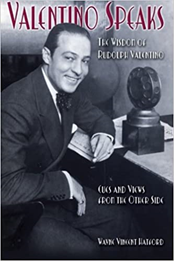
These teachings were published in 2011 as the work Valentino Speaks: The Wisdom of Rudolph Valentino: Cues and Views from the Other Side. In the year 2020 another volume was published by Hatford titled Rudolph Valentino on the 2020's

With almost a hundred years since his passing, Valentino's role as a Spirit Guide within the Spiritualist movement seems to renew itself with every generation of Spiritualists, offering messages of hope and wisdom to anyone who cares to listen.  

Monday, October 11, 2021

Rev. Anthony Camardo

I came across Rev. Anthony Camardo while I was researching Italian-Americans involved with American Spiritualism, and he's quickly become one of my favorite people I've researched. Rev. Anthony Camardo was an Italian-American Spiritualist from Chicago. He was described as "a short and cheerful man," affectionately called "Tony" by his congregation. He was founder of the Liberal Psychic Science Association, and Pastor of the Liberal Psychic Science Church. 

In 1928 the 27 year old Camardo was drawn into a somewhat high profile criminal investigation. An eight year old named Billy Ranieri was kidnapped on his way home from school in Chicago, and held for ransom. Ranieri was rescued and his kidnappers were caught, and it was discovered that one of the men had a business card of Anthony Camardo's in his wallet. Camardo was questioned by the State Attorney; he explained that he had only met the man once, and that he was brought as a guest to a séance that he had facilitated. 

In 1935 Anthony Camardo was listed as a member of the First Italian Spiritualist Church, where he would regularly assist in Sunday Services. By 1937 Rev. Anthony was ordained as a Spiritualist Minister and was leading his own congregation; in 1941 he formed his own Spiritualist Association, the Liberal Psychic Science Church. 

A few different articles describe Camardo's church; the main entrance lead to a fellowship hall on the ground floor. This fellowship hall had folding chairs and several tables with small packages of incense for sale for 25 cents. A reporter made note of a few song birds that were in cages, a parrot, a few tanks of fish, and two resting dogs (a spaniel and a bulldog) were present in the fellowship hall during his visit. 

The sanctuary was somewhat dark, with rows of folding chairs; the platform had a lectern, and a wooden altar table with a cross. The windows in the sanctuary overlooked a small garden. There was a painting of Jesus in a white robe, a few statues of Catholic Saints, and some busts of figures in Turbans. 

The church hosted regular Sunday Services, as well as Wednesday night services. The congregation also met for monthly development circles. One particularly interesting feature of Rev. Camardo's church service is that in addition to Healing and Messages typical of most Spiritualist Churches, the Liberal Psychic Science Church also offered Communion to the congregation on a fairly regular basis, which is somewhat unusual for most Spiritualist Churches.

The Church also had an auxiliary organization called the Liberal Psychic Science Welfare Federation, which organized events such as a Christmas Bazaar, Holiday Parties, and Church dinners (chicken and spaghetti, lasagna, and ravioli were mentioned).

In 1948 Camardo served as President of the Federation of Spiritual Churches and Associations, which was the American branch of the International Spiritualist Federation. He served alongside notable Spiritualists such as John & Helen Gerling of Rochester, New York and also Rev. A. Mae Baxter Gruner, the President of Harmony Grove Spiritualist Camp in Southern California. He was described as one of the pillars of the organization: 

"Tony" Camardo has many virtues, but there is one high quality which he possesses that so overshadows all others that the one word which is most apt to characterize him is FRIENDLY. His great and good work is the true embodiment of friendlies, which reaches out to folks and makes them want to listen to the Voice of Spirit that works through him. Rev. Anthony Camardo was elected to the Federation at the Chicago Convention of 1946." 

In 1950 a reporter for the Chicago Tribune attended one of Rev. Camardo's Wednesday Night Development Circles. The meeting began at 7pm, with a gathering consisting of about 30 thirty people, mostly women, and most of them older with a handful of individuals in the 20-30 year age range. 

The meeting began with a short lecture given by Rev. Camardo on the importance of meditation for spiritual development, and also the importance of the influence of the moon on people. After a short break the Mediums prepared for the message service. Four aluminum spirit trumpets and a child's slate were placed on the floor in the center of the circle, and the lights were dimmed. The sitters were asked to place their feet firmly on the floor, with their palms resting upwards. 

The opening prayer was the 23rd Psalm, and Rev. Camardo lead the gathering in raising the vibrations for spirit communication. After about 20 minutes some small noises seemed to be produced from the Trumpet, and Camardo asked all gathered to share any messages that they had received for themselves or for others, and some for friends not in attendance. The meeting ended with coffee and cake. Camardo then invited the reporter to get pizza around the corner after everyone left. 

In 1956 Camardo lead his congregation on a retreat to Chesterfield Spiritualist Camp, where they stayed for a week to attend lectures, classes, and demonstrations of psychic phenomena. Camardo represented Chicago for "Illinois Day" during the Camp. Two notable Puerto Rican Espiritistas (Victor M. Ramos, and Judge Victorio M. Fernandez) made a special 3,000 mile trip to visit Camp Chesterfield and and study with American Spiritualists. Rev. Camardo was chosen to act as host, and helped as an interpreter for the guests. 

In a 1964 article from the Chicago Daily News, a description was given of a marriage counseling session that was conducted by Camardo for two reporters disguised as a couple. The reporters in the article openly admitted that they had not researched what the session would be like, and were disappointed that it was not similar to a psychological counseling as they had expected. Instead Rev. Camardo offered a lesson on mental healing, meditation, and positive affirmations that couples could use to improve and heal their relationship. 

Rev. Anthony Camardo passed away in January 1972 at age 71.

From Puerto Rico to Rochester, New York: International Spiritualism in 1948

A very niche interest of mine is the overlap between the traditions of Spiritualism, Spiritism, and Espiritismo. Part of that comes from my ...